
 Louis Daguerre
Street photography: part 1
From the earliest images of the city to the modern photographic gaze
(Bozhinov, A. The Photographic Image in a Communication Context. Sofia: St. Kliment Ohridski University Press, 2022)
What might lie behind this phrase? As a form of activity, ‘street photography’ has been part of professional jargon for some forty to eighty years, acquiring nuances of meaning along the way. Today, it can confidently be described as a genre in its own right, with its own rules, examined in detail in Professor Tsocho Boyadzhiev’s essays ‘The Street, or On the Banal in Photography’ (Boyadzhiev, 2015). Equally interesting is the path this kind of photography has followed from the emergence of the photographic process to the present day. The street offers a wealth of subjects: buildings, fountains, bridges, monuments; neighbourhood gardens and parks; vehicles, shops, cafés, people. Yes. The crowd. A phenomenon that has always accompanied the city, but grew in numbers during the nineteenth century, the age of industrialisation, when Europe’s first great metropolises, Paris and London, took shape. Later, other cities around the world also reached populations in the millions. The crowd is heterogeneous, encompassing people from different social classes, temporary residents, tourists, musicians, performers, street vendors, rag-and-bone dealers, thieves, beggars… Photography emerged at that time, in 1839, but… lagged a little behind the rhythm of its age. For its first few decades, it was still too slow to compete on equal terms with poets, writers, painters and others in the flâneur’s exploration of the urban environment (see Boyadzhiev, 2015). Baudelaire, the flâneur, had a photographic eye:
‘The boulevard roared, spreading like a river.
Tall, slender, clothed in deepest mourning,
She passed before me, holding up her veil
With her beautiful and regal hand.
…
A flash… Then darkness!… Sudden beauty,
Whose radiant eye brought me to life in an instant,
Shall I never meet you again, except in eternity?’ (Baudelaire, 2006)
The very essence of the moment! The street photographer’s principal means of expression… In outlining the figure of the flâneur, Professor Boyadzhiev turns to Walter Benjamin’s study ‘Charles Baudelaire: A Lyric Poet in the Era of High Capitalism’, while also mentioning Sainte-Beuve, Balzac and Victor Fournel.
Perhaps instinctively sensing the threat posed by the new medium, Baudelaire described photography as ‘the deadliest enemy of art’ (Hacking, 2014).
For him, the utilitarian (and commercial) function of this new method of representation stripped the image of the cultural layers in which art clothed it.
In ‘The Flowers of Evil’, the crowd is an indispensable protagonist, sometimes explicit, at other times implied.
In the very beginning, the low sensitivity of photographic materials and the limited light-gathering capacity of lenses left the streets in photographs deserted, as in this daguerreotype, where only a few stationary human figures can be discerned.
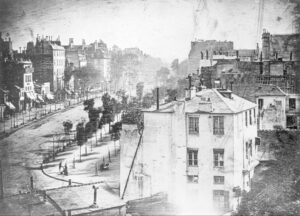
Boulevard du Temple, Daguerre, 1840
The development of photography has been shaped by three factors: the work of a small number of photographers who charted some of its directions, leading to the emergence of distinct stylistic movements; the processes unfolding within society; and, not least, technological advances in the medium. Benjamin’s study of Baudelaire provides a wealth of contextual information about the spirit of the age. Its descriptions of the crowd reveal not only that each of the writers cited focuses on different characteristics (Hugo, Dumas, Marx, Engels, Balzac, Dickens, Poe, Baudelaire himself and others), but also that crowds differ. The London crowd, for example, is more hurried and businesslike, whereas the Parisian crowd, as one might expect in the mid-nineteenth century, seethes and boils, and ‘bohemia’ comprises a colourful and heterogeneous group of rebels. Walter Benjamin adds another crowd of his own, from the twentieth century: one that, in the light of subsequent historical experience, inspires horror — the fanatical crowd. ‘Such crowds often have only a statistical existence, which conceals what is monstrous about them: namely, the concentration of private individuals as such through the chance convergence of their private interests. When these crowds become a frequent occurrence — and totalitarian states ensure this by continually obliging their clients to gather for every event — their hybrid character becomes apparent. …They declare chance (…) to be “destiny”, which reunites the “race”’ (Benjamin, 1989).
Yet the picture of mid-nineteenth-century Paris would be incomplete without one further detail, which gradually becomes a protagonist in its own right: the cobblestone barricades. More than once, the cobblestones of Paris blocked its streets, defending citizens against the repressive apparatus of the state. An anonymous photograph from the Paris Commune of 1871 lends this protagonist an unsettling aesthetic form, borrowing the visual language of boulevard postcards while adding ghostly human figures blurred by the long exposure.
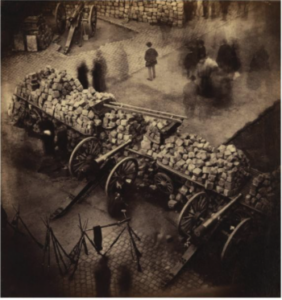
anonymous 1871 (anonymous, 2010)
Ninety-seven years later, in 1968, another photograph, by Gökşin Sipahioğlu (1926–2011), became a symbol of the student protests against the government.
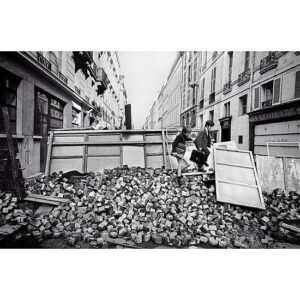
Sipahioğlu 1968 (Sipahioğlu, 2018)
To understand the path photography has taken, we must also examine the cultural situation of the time. The emergence of the realist novel at precisely this moment was no coincidence (some of its representatives have already been mentioned). Similar processes were unfolding in painting. Courbet declared himself a realist, by which he meant freeing the medium from the cloak of pathos and allegory in which millennia of tradition had enveloped it. Verismo emerged in opera. Photography was not yet searching for its identity; it had many technical problems to solve. Yet it was steadily establishing its place in society. The average consumer likewise gave the matter little thought, simply accepting the newly emerged still image as identical to its referent. Not mimesis or representation, but coincidence, sameness. Thus, apart from perceptive minds such as Baudelaire’s, no one recognised that photography effortlessly achieved this longed-for release from the weighty, solemn shackles of allegory: such was its nature. And its drama — natural in origin on the one hand, cultural on the other, endowed with the value society adds to it. But for this opposition to unfold in its full dimensions, time was needed for those cultural layers to accumulate. And the photographers who intuitively found the point of conflict were destined to enter history…
Here is another curious photograph from the dawn of photography, by Hippolyte Bayard, who devised a process situated between daguerreotypy (the invention of Daguerre, Paris, 1839, credited as the inventor of the photographic process: a direct positive image on a polished silver plate treated with iodine vapour; daguerreotypes are unique objects) and talbotypy (two years later, William Fox Talbot patented in London the negative–positive process, which allows an image to be reproduced multiple times from a single negative). Bayard’s process produced a direct positive image on paper. The street is packed with people: a celebration, a performance, perhaps an execution? In fact, a procession.
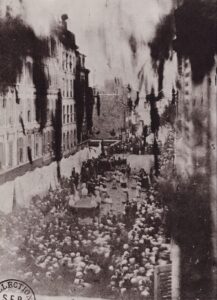
Bayard 1842
While photography wandered between the commercial portrait, popularised in the form of the carte de visite, the stereoscope, and pictorialism — confined to circles of initiates and, as its name suggests, seeking to emulate painting, in this case Impressionism — an eccentric named Eugène Atget set about meticulously turning the French capital into poetry at the turn of the century. Carrying a heavy wooden camera and tripod, he refused to be regarded as an artist. He sold his photographs to architects and interior designers, and was later commissioned by the municipal authorities to photograph buildings and streets in outlying districts scheduled for demolition and redevelopment. His work impressed Man Ray, the artist who had arrived from New York. After the photographer’s death in 1927, glass plates purchased and donated to MoMA by Ray’s assistant, Berenice Abbott, were exhibited at the museum, establishing Atget’s international reputation (ATGET, 2001).
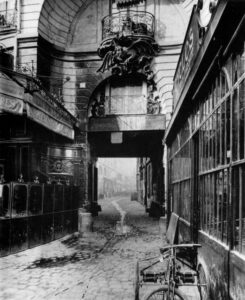
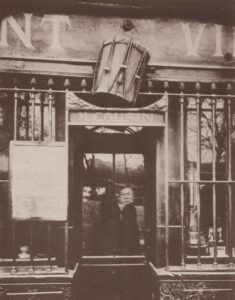
Eugen Atget: Paris, no date
To the end of his life, he stubbornly refused to change his equipment, even though far more compact and practical cameras had come onto the market, explaining that this was the only way he knew how to take photographs. In his images, the city is still deserted, but rendered in exquisite detail. Shortly after he began his career, the child prodigy of French photography was born: Jacques Henri Lartigue (1894–1986). He came from a wealthy family and was given a plate camera at the age of seven. Photographic materials were already considerably more sensitive, and lenses faster, so photographing moving subjects was no longer a problem. At eight, he received a Kodak Brownie No. 2. His favourite pastime became photographing sports, people jumping and running, aeroplanes, motor racing, tennis and sailing — in short, the amusements available to the wealthy bourgeoisie. He quite literally placed the camera between himself and his surroundings, creating a panoramic portrait of middle-class life during the Belle Époque, before the First World War and between the wars. Much of his archive was stored away during the turbulent war years and discovered in a cellar in the early 1960s. The Rapho agency passed it on to John Szarkowski, who organised an exhibition of his work at MoMA in New York in 1963. This brought Lartigue worldwide recognition (LARTIGUE, 1990).
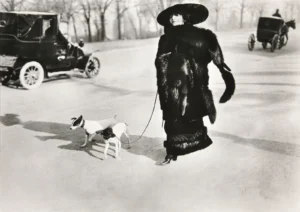
Lartigue
From the post-First World War decades of the 1920s and 1930s to the present day, there has been no overturning of established norms as radical as Modernism. Photography had already acquired sufficient social prestige and confidence. Accepted as an appealing companion to civilisation, born of modern times, it took its rightful place in this process, boldly seeking means of expression of its own, distinct from those of classical visual art. Developments in photographic equipment also helped. The Leica, which appeared in 1926, could easily fit into a pocket. It had two further significant advantages. Its rangefinder viewfinder allowed the photographer to watch the surroundings with one eye while framing with the other… admittedly, no easy operation, and one for masters alone. Then there was the leaf shutter, housed in the lens, which was exceptionally quiet and allowed slower shutter speeds because it caused no vibration and… was difficult to hear even on a relatively quiet street.
The Leica worked wonders in the hands of modern artists. In the USSR, Alexander Rodchenko (1891–1956) explored bold camera angles, compositions and the play of light (RODCHENKO, 2008).
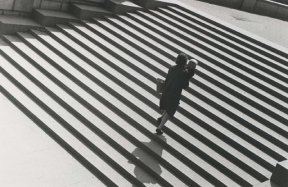
André Kertész
At the Bauhaus, László Moholy-Nagy constructed his light sculptures, while the Surrealists in Paris were intoxicated by the possibilities the street offered for exploring beyond reality: juxtapositions encountered (only?) in dreams… Only now, in the 1930s, did photography burst forth like a firework whose fuse had been laid by the realists of the previous century. Some of the pioneers with a cooler, more detached gaze were émigrés from the now former Austro-Hungarian Empire, and their subject was once again Paris. André Kertész (1894–1985), a contemporary of Lartigue and a Hungarian of Jewish origin, was distinguished by an acute sense of time’s fleeting nature and the play of light and shadow.
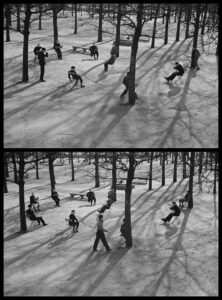
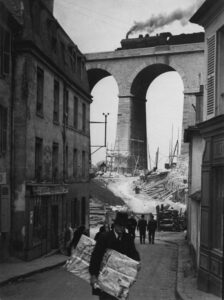
Andre Kertesz Meidon, 1928 (BORHAN, 1994)
He received his first camera in 1912, gained experience (and built an archive) during the First World War and the Hungarian Revolution of 1919, and emigrated to France in 1925. Some historians claim that his was the first solo photographic exhibition in history. Gyula Halász, who adopted the pseudonym Brassaï (1899–1984) after his native Brașov, undertook the first in-depth exploration of nightlife in the city of millions. He settled in Paris in 1925 and published ‘Paris by Night’ in 1933 (GAUTRANG, 2008).
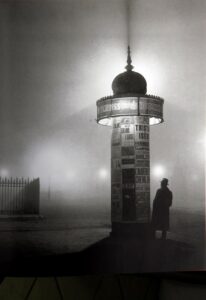
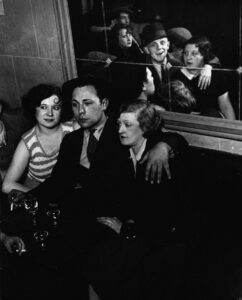
Brassai: Paris, 1932
In fact, it was not until eighty-six years later that I encountered a similarly detailed and sustained photographic exploration of nightlife, in Ken Schles’s documentation of New York after dark. This despite the fact that, in purely technical terms, the sensitivity of photographic materials in difficult lighting conditions then and now is beyond comparison. After these two photographers’ initial explorations — which were, in fact, quite bold — around the turn of the 1930s, Paris once again became the ‘collective protagonist’ of a substantial photographic community. The photographers were numerous; the photographs, extraordinarily so. Édouard Boubat, Izis, René Burri, Robert Doisneau, Willy Ronis and, of course, Henri Cartier-Bresson are merely the best-known among them (GAUTRANG, 2004). The older generation used medium-format twin-lens reflex cameras with waist-level viewfinders, shooting, as it were, ‘from the stomach’. They viewed the image from above, with left and right reversed, which did not prevent them from capturing remarkable reportage photographs, as Robert Doisneau did.
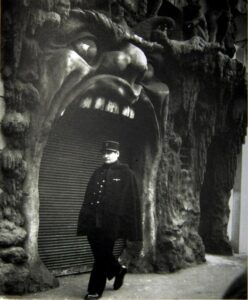
The younger generation used small-format Leica-type cameras. A conflict even arose between the two groups. Izis was also an émigré of Lithuanian Jewish origin who settled in Paris in 1930. During the occupation, he was forced to leave the city, yet nevertheless ended up in a camp, from which he managed to escape with the help of the Resistance.
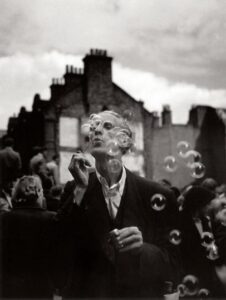
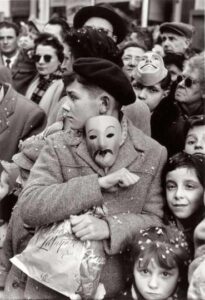
Jhones, B.
Author: Antoan Bozhinov